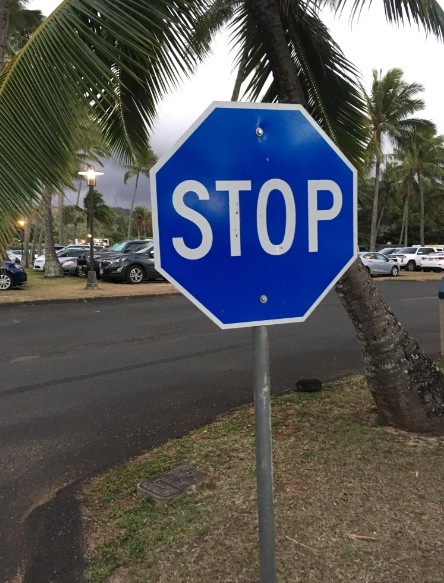
In the United States, traffic signs on public roads are designed to follow clear national rules. These standards come from the Manual on Uniform Traffic Control Devices (MUTCD), which exists to keep driving predictable and safe. One of its most recognizable results is the stop sign: a red, eight-sided sign with white lettering that looks the same everywhere. This consistency helps drivers instantly recognize what is expected of them.
The familiar red color is not a random choice. Red is widely associated with attention and urgency, making it easy to notice even in poor weather or low light. Combined with the unique octagonal shape, the design allows drivers to identify a stop sign quickly, sometimes even before reading the word itself. This visual reliability is a key reason the design has been adopted and maintained for decades.
Occasionally, people come across stop signs that are blue instead of red. These can raise questions, but they are not used on public streets. Blue stop signs are typically placed on private property, such as parking areas, private roads, business complexes, or residential communities. In these locations, owners have more flexibility and may choose different colors to suit layout needs or design preferences.
Even though traffic rules can differ on private property, blue stop signs still play an important role. They help guide movement, reduce confusion, and encourage drivers to proceed carefully where vehicles and pedestrians share space. Following these signs is a practical way to promote safety and courtesy. Simply put, red stop signs remain the official standard on public roads, while blue ones are used privately—and stopping when prompted is always a smart habit.