
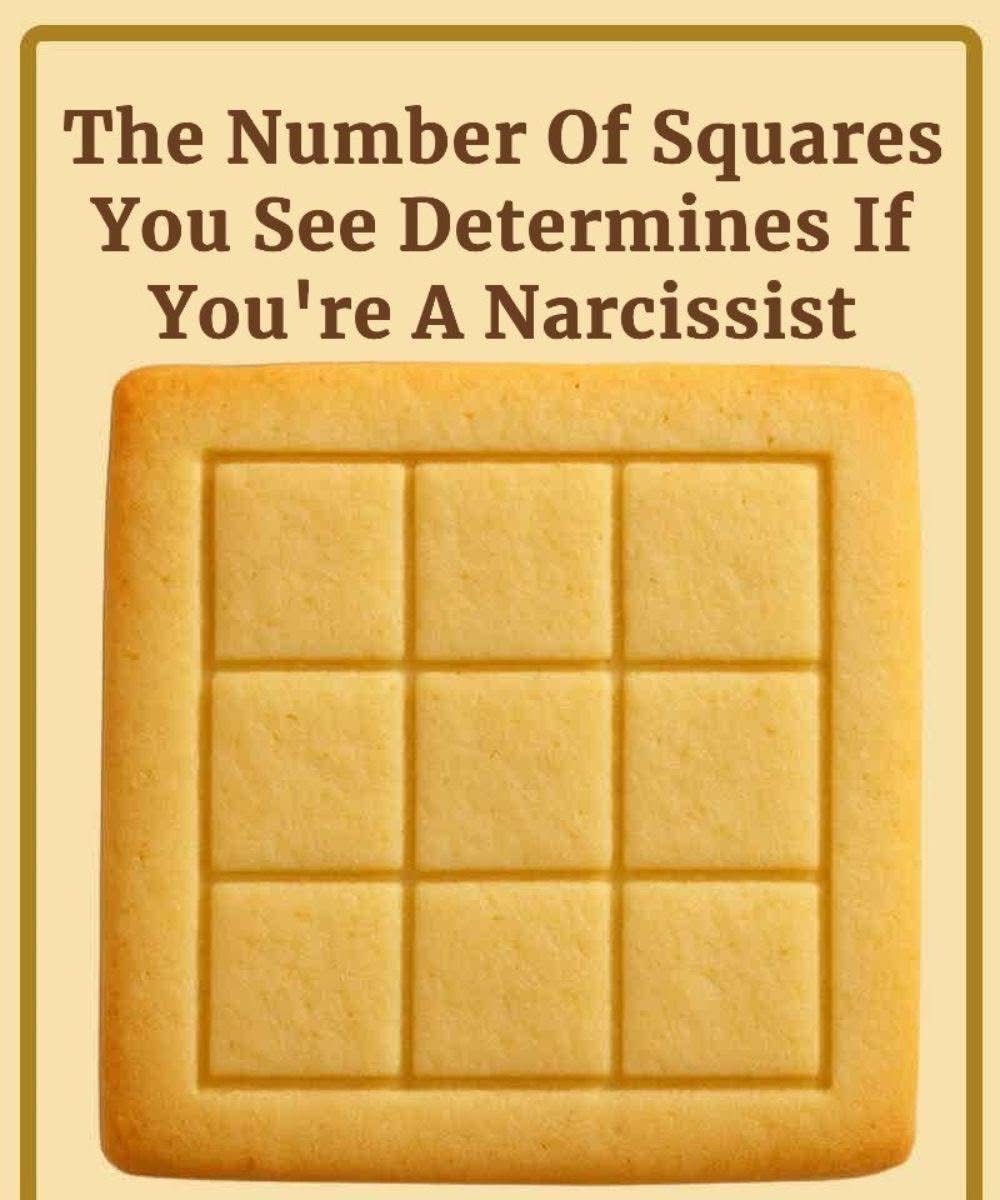
At first glance, the image looks simple — a square divided into smaller sections, almost like a neatly scored piece of dough. Yet the playful caption claiming that “the number of squares you see determines if you’re a narcissist” instantly captures attention. It’s a classic example of how the internet blends visual puzzles with pop psychology. Before jumping to conclusions, it’s worth exploring what this illusion actually demonstrates — and what it clearly does not.
Start by counting carefully. Many people initially identify nine smaller squares arranged in a grid. With closer inspection, additional shapes become visible: four larger squares formed by grouping smaller sections, plus the large outer square that frames them all. In total, there are fourteen distinct squares. The exercise highlights how our brains process patterns. Some individuals focus first on the most obvious shapes, while others instinctively scan for layered structures and hidden configurations.
The personality labels attached to this puzzle are meant purely for entertainment. Online interpretations often suggest that spotting fewer squares indicates a relaxed mindset, while noticing all fourteen signals strong attention to detail — sometimes jokingly linked to perfectionism. However, there is no scientific evidence connecting square-counting ability to narcissism or any other personality trait. True narcissistic traits are defined by complex behavioral patterns, not by how someone interprets a visual pattern.
What makes the illusion engaging is not the result, but the reaction. Did you feel satisfied when you found more squares? Frustrated if you missed a few? Amused by the playful “diagnosis”? Those responses reveal more about mood and curiosity than about character. Ultimately, puzzles like this remind us that perception varies from person to person — and that curiosity, not ego, is what drives us to look a little closer.