
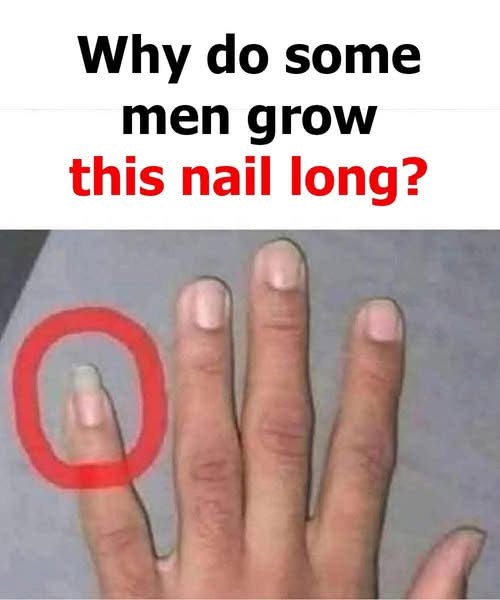
From time to time, you may notice a man whose fingernails are neatly trimmed—except for the pinky finger, which is noticeably longer. At first glance, it might appear unusual, but this small detail can have several explanations. Depending on the person and cultural background, a long pinky nail may represent tradition, practicality, or simply a personal style choice. Understanding the different possibilities helps explain why this habit appears in many parts of the world.
One common explanation relates to cultural or historical traditions. In certain regions of Asia, the Middle East, and Latin America, a long pinky nail was once associated with social status. Historically, people who did not perform manual labor sometimes kept one nail long as a subtle sign of education or wealth. While this symbolism is less common today, some individuals continue the practice as a nod to heritage or family traditions.
For others, the reason can be purely practical. A slightly longer pinky nail can function as a small tool for everyday tasks. Some people use it to open packages, remove small stickers, clean under other nails, or press tiny buttons on electronic devices. Musicians who play certain instruments—particularly those using fingerstyle techniques—may also keep one nail longer to improve control when plucking strings.
In some cases, the long pinky nail is simply a matter of personal identity or fashion. Small details like hairstyle, jewelry, or nail length can be used as forms of self-expression. While certain stereotypes exist around this habit, there is no single universal meaning behind it. The reason often depends on individual preference, cultural background, or convenience. As with many personal habits, what seems unusual at first may simply reflect a unique style or tradition.