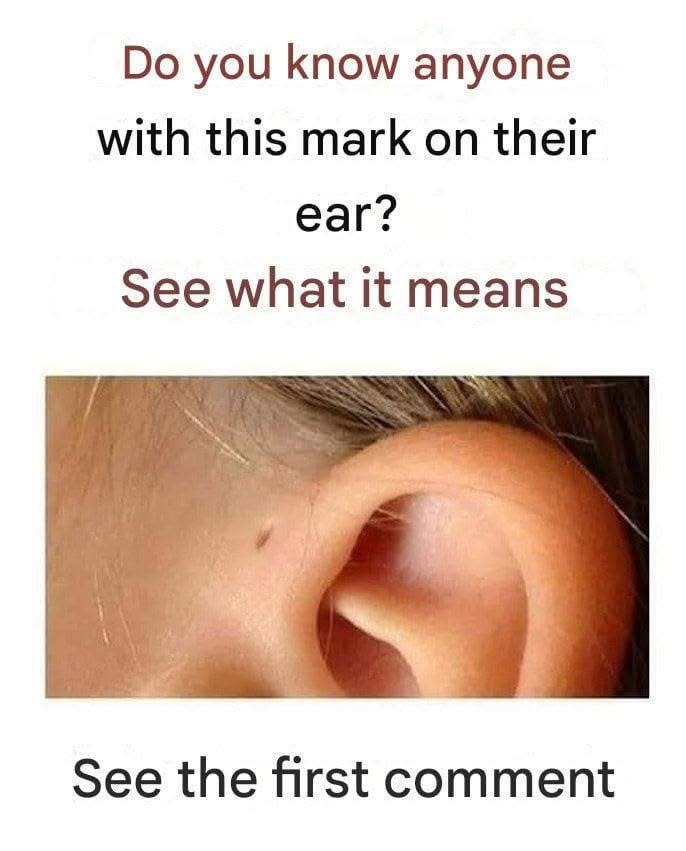
If you’ve ever noticed a small hole or indentation just in front of someone’s ear, you may have wondered what it is. Many people assume it’s a healed piercing, a faint scar, or a minor skin irregularity. In most cases, however, this tiny opening is something present from birth. Medically known as a preauricular pit (or preauricular sinus), it is a small congenital feature that forms during early development. Because it rarely interferes with hearing or daily life, many individuals don’t realize it has a specific medical name until a healthcare provider mentions it during a routine exam.
This feature develops very early in pregnancy, when the structures of the outer ear are forming. During this stage, several small tissue segments must merge in a precise pattern. If the fusion is slightly incomplete, a narrow tract or opening may remain near the ear. This variation is typically harmless and is not considered a defect in growth. In some families, it appears across generations, suggesting a hereditary component. It may occur on one ear or, less commonly, on both. In the vast majority of cases, no treatment is required.
Although usually benign, a preauricular pit can occasionally become irritated or infected. When bacteria enter the small tract, symptoms such as redness, swelling, tenderness, or discharge may occur. These situations are manageable with medical care, often involving antibiotics. If infections recur frequently, a minor surgical procedure can remove the tract to prevent future episodes. Importantly, even when intervention is needed, the condition does not affect hearing, cognitive development, or overall health.
Beyond medicine, this small feature has inspired curiosity in different cultures, sometimes associated with symbolic meanings or folklore. From a scientific perspective, however, it is simply a natural variation in human anatomy. Learning about it often replaces uncertainty with reassurance. Ultimately, the preauricular pit serves as a reminder that subtle differences are part of normal human diversity—small details shaped long before birth that rarely require concern but often spark fascinating questions about how we develop.