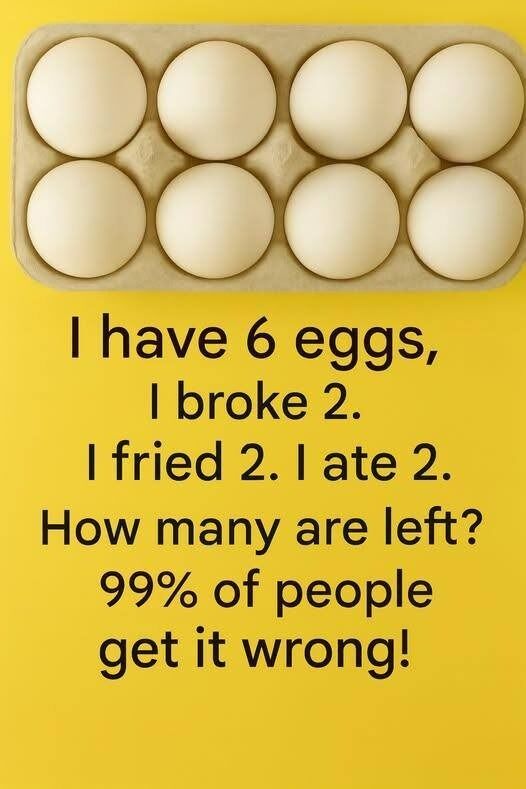
Brain teasers are designed to appear simple while quietly testing how quickly we make assumptions. A popular example is the familiar “six eggs” riddle, which continues to resurface online because it highlights how easily wording can guide our thinking. The real challenge isn’t calculation—it’s learning to pause, read carefully, and understand the order of events before reaching a conclusion.
The scenario is usually short and straightforward: six eggs are mentioned, followed by actions like breaking, frying, and eating two eggs. Many readers instantly assume that each action involves a different pair. That fast interpretation leads to the belief that all six eggs have been used. This reaction feels logical at first because the brain often jumps to totals instead of tracking how each step connects to the next.
A closer and calmer reading changes everything. Eggs must be broken before they can be cooked, and they must be cooked before they can be eaten. This means the same two eggs pass through all three steps. No additional eggs are involved beyond that single pair, even though the phrasing encourages readers to think otherwise. The remaining eggs are never touched at all.
The lesson behind this puzzle is a valuable one for everyday life. It shows how important it is to slow down and focus on sequence rather than assumption. Brain teasers like this aren’t meant to confuse—they’re reminders that careful reading leads to clearer thinking. With just a moment of attention, the answer becomes obvious: four eggs remain untouched.