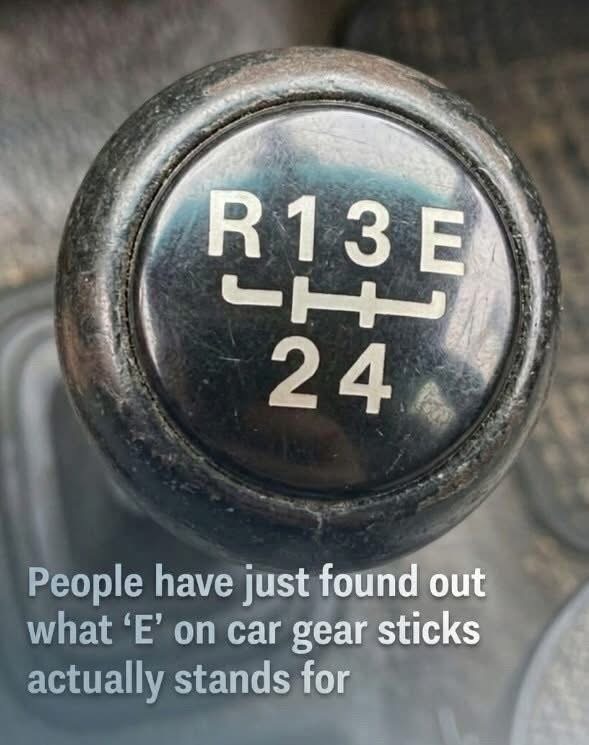
For many years, vehicle gear selectors followed simple and familiar layouts that most drivers instantly recognized. Manual transmissions commonly displayed numbered gears alongside “R” for reverse, while automatic vehicles featured standard markings such as “P” for park, “N” for neutral, and “D” for drive. Because these systems became so widely used, many drivers rarely stopped to consider the meaning behind every symbol appearing on older gear selectors and dashboards.
That is why some people become curious when they notice the letter “E” on certain older vehicles. Unlike modern driving modes displayed digitally, this feature was more common in earlier generations of automobiles and has largely disappeared from newer models. In many cases, the “E” stood for “Economy,” a setting designed to help improve fuel efficiency during everyday driving conditions.
Economy mode typically adjusted the behavior of the engine and transmission to reduce fuel consumption. When activated, the vehicle often shifted gears at lower engine speeds and softened throttle response to prioritize efficiency over rapid acceleration. Drivers frequently used this setting during highway travel or steady-speed driving, especially during periods when fuel conservation and rising gas prices became important concerns for many households.
Although dedicated Economy gear settings are less common today, the idea behind them still exists in modern automotive technology. Many newer vehicles now rely on advanced computer systems that automatically optimize fuel use, engine performance, and transmission behavior in real time. The old “E” setting remains an interesting reminder of how automotive engineering evolved over the years—from simple manual efficiency controls to highly sophisticated systems focused on balancing comfort, performance, and fuel economy automatically.