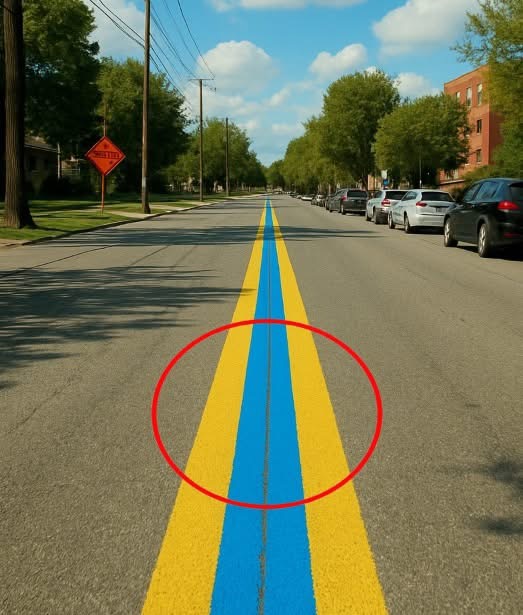
Most drivers rarely think twice about the markings painted across roads and highways, yet these lines play an essential role in guiding traffic and improving safety. From lane dividers to directional arrows, road markings help organize movement and reduce confusion for millions of motorists every day. Recently, however, some communities across the United States have introduced an unusual addition: a thin blue stripe positioned between the traditional double yellow center lines. Although subtle in appearance, the marking has quickly attracted attention and curiosity from drivers unfamiliar with its purpose.
In several areas, the blue line is intended as a symbolic gesture recognizing local law enforcement officers and the work they perform within their communities. Supporters describe the marking as a visible sign of appreciation for officers who respond to emergencies, assist during crises, and help maintain public safety. While interpretations may vary between communities, the stripe is generally viewed as a respectful acknowledgment of the responsibilities carried out by local police departments and first responders.
Beyond symbolism, the blue stripe can also serve a practical purpose in some locations. Certain towns use the marking to help guide residents and visitors toward nearby police facilities or public safety offices. One widely discussed example can be found in Ocean City, where a blue line along 65th Street leads toward the local police department headquarters. Community leaders there have described the addition as both a navigational aid and a visual reminder of the importance of public safety services, particularly in areas that experience large seasonal tourism crowds.
Supporters believe similar markings may encourage awareness and reinforce the connection between communities and local public safety personnel. Whether viewed primarily as a directional feature or as a symbolic tribute, the blue stripe has become an interesting example of how even small changes in everyday infrastructure can carry broader meaning. For many drivers, the unusual road marking serves as a reminder that the systems guiding daily travel often reflect not only traffic organization, but also the values and priorities of the communities they serve.