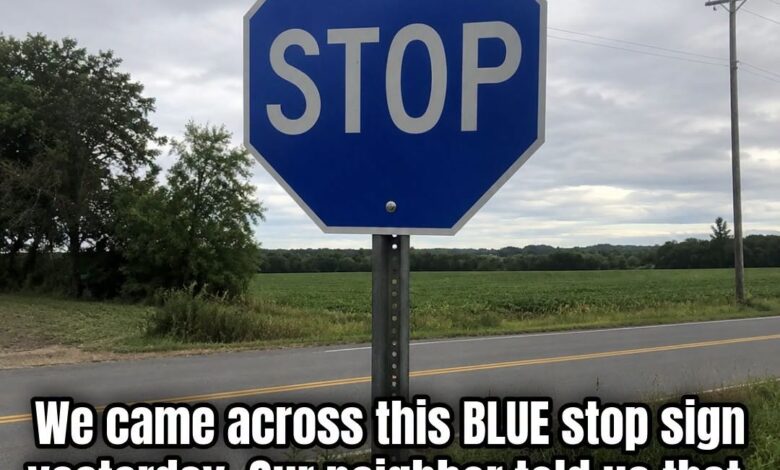
Most drivers instantly recognize the traditional STOP sign: an eight-sided shape with a red background and white lettering. That familiarity is exactly why seeing a blue version can be confusing and may leave drivers wondering whether it represents a different traffic rule. In the United States, official signs used on public roads follow established standards, and the recognized design for a mandatory stop remains the familiar red octagon with white “STOP” lettering. A blue sign with the same general appearance does not match that standard, so it typically should not be interpreted as a new nationwide category of official stop sign.
To understand why blue STOP signs sometimes appear, consider where they are located. Nonstandard versions may be found on private property, in parking lots, residential communities, university campuses, industrial facilities, or business complexes. Property owners and organizations sometimes install their own signs to manage vehicle movement within these areas, and those signs may not use the same colors as official public-road signage. Decorative signs can also resemble traffic signs. Therefore, encountering a blue STOP sign does not necessarily indicate that traffic authorities have introduced a new rule; the surrounding location often provides the most useful context.
The familiar red color also has a practical and historical purpose. Early American stop signs did not always look exactly as they do today, and some older versions used yellow backgrounds with darker lettering for visibility. As reflective materials and sign-making technology improved, red became firmly associated with stopping and certain prohibitions. Other colors developed recognizable functions as well: yellow commonly warns of hazards or changing road conditions, green generally provides directional and destination information, while blue is often associated with traveler services and information. Consistent use of these colors helps drivers interpret important instructions quickly, particularly when traveling through unfamiliar areas.
If you encounter a blue STOP sign, the sensible approach is to slow down, observe your surroundings, and follow the traffic instructions established for that location. A different color should not automatically be treated as permission to ignore the sign, especially on private property where internal traffic rules may apply. Watch for pedestrians, other vehicles, pavement markings, and additional signs that clarify how traffic should proceed. Ultimately, blue STOP signs attract attention because they differ from what drivers normally expect, while the red-and-white octagonal STOP sign remains the standard design for official stop control on public roads in the United States.