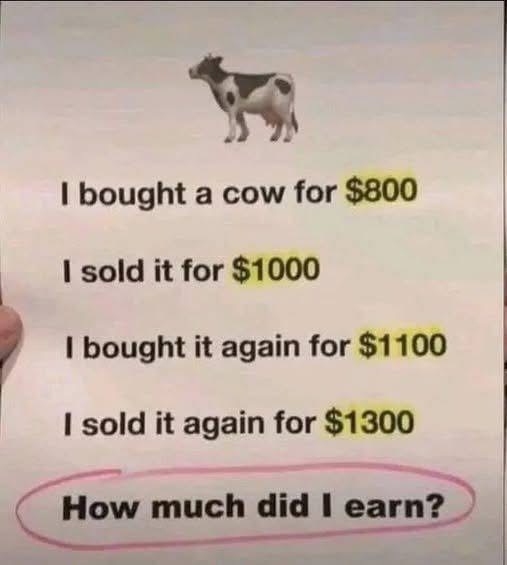
A puzzle with one cow and four clean numbers may look simple at first, but it often confuses people because it moves in steps. The story usually goes like this: you buy a cow for $800, sell it for $1,000, buy it again for $1,100, and sell it again for $1,300. The mistake many people make is trying to solve everything at once. A clearer method is to slow down and treat each buy-and-sell moment as its own small transaction.
First, look only at the first deal. You spend $800 and later receive $1,000, which gives you a profit of $200. Then move to the second deal. You spend $1,100 and later receive $1,300, giving you another $200 profit. When each step is separated, the puzzle becomes much easier to understand because there is no hidden fee, trick condition, or extra rule—just two simple gains.
Now add the two profits together: $200 from the first transaction plus $200 from the second transaction equals $400 total profit. You can also confirm it another way by adding all money spent and all money received. Total spent: $800 + $1,100 = $1,900. Total received: $1,000 + $1,300 = $2,300. The difference is $2,300 − $1,900 = $400.
The real lesson is not just about arithmetic—it is about careful thinking. Many mistakes happen when we rush, combine steps too early, or trust a quick guess more than the process. This puzzle is a useful reminder that even simple problems become clearer when we break them into smaller parts, follow the order carefully, and let each step tell its own story.