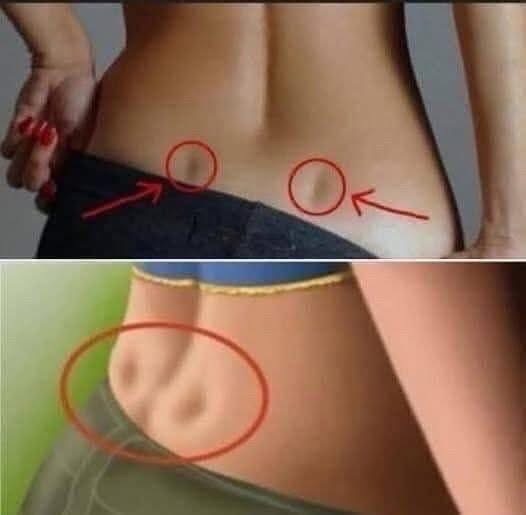
The small indentations found on the lower back, just above the hips, are often referred to as “dimples of Venus.” While subtle, they tend to draw attention because of the way they gently shape the body’s natural lines. Rather than being a dramatic feature, their appeal lies in their simplicity, adding a sense of balance and symmetry that many people find visually pleasing.
These dimples are entirely determined by genetics and are not influenced by exercise, diet, or lifestyle. Unlike features that can be developed or changed over time, they are part of a person’s natural structure and remain consistent throughout life. This makes them a unique characteristic—something that is simply inherited rather than achieved. Their presence or absence varies from person to person, reflecting the natural diversity of the human body.
From an anatomical perspective, these indentations form where the pelvic bone sits closer to the skin. In this area, connective tissue links the skin to the underlying structure, creating a slight inward curve. Because there is less muscle and fat covering this region, the dimples can appear more defined. Their position often aligns with the body’s natural symmetry, which contributes to their aesthetic appeal.
Although they are often associated with beauty in art and popular culture, it’s important to recognize that they do not indicate health, fitness, or any special function. They are simply a natural variation in anatomy. Understanding this can help shift the focus from comparison to appreciation, highlighting that features like these are just one of many ways human bodies differ—each equally natural and valid.