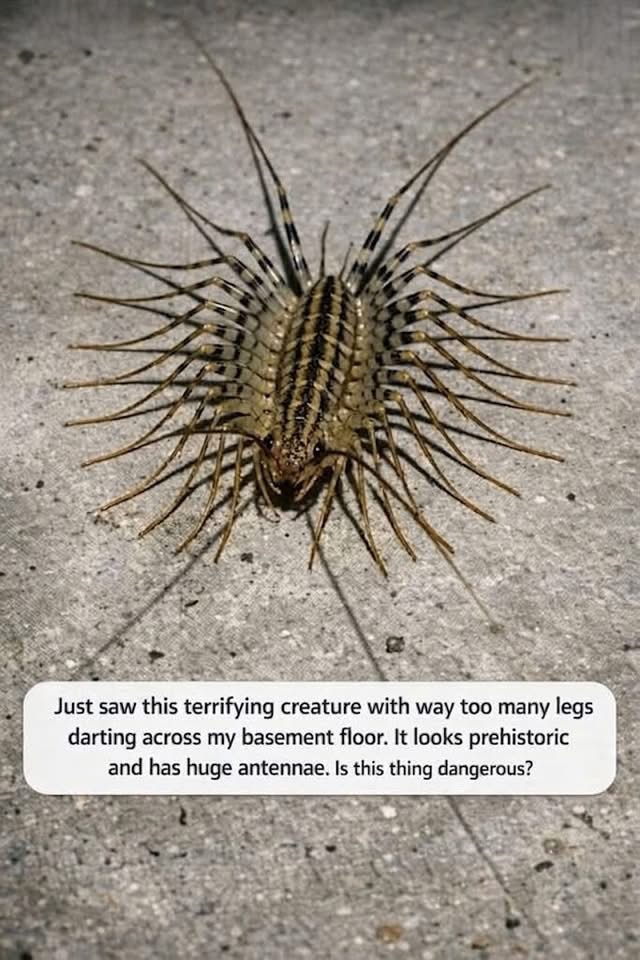
Spotting a fast-moving, many-legged insect racing across a basement floor can be an unsettling experience for almost any homeowner. With its long legs, quick movements, and unusual appearance, the House Centipede often surprises people the moment it appears indoors. These insects are commonly found in damp areas such as basements, bathrooms, crawlspaces, and laundry rooms, where cooler temperatures and moisture create ideal conditions for survival. Although their appearance may seem intimidating at first, understanding what they are and why they enter homes can make the situation feel far less alarming.
House centipedes are known for their remarkable speed and distinctive body structure. They typically have a yellowish-gray body with dark stripes and up to fifteen pairs of long legs that allow them to move quickly across floors and walls. Their long antennae help them detect vibrations and movement in dark spaces, making them highly effective nighttime hunters. While this combination of speed and movement can make them appear intimidating, their behavior is generally defensive rather than aggressive. In most cases, house centipedes prefer to avoid humans entirely and immediately search for a place to hide when disturbed.
Despite common fears, house centipedes are considered relatively harmless to people and household pets. Although they possess venom used for capturing tiny insects, their bite is uncommon and usually mild if it happens at all. More importantly, these insects actually play a useful role indoors by feeding on other household pests. Their diet often includes spiders, ants, cockroaches, silverfish, termites, and other insects many homeowners actively try to eliminate. In that sense, house centipedes function as a form of natural pest control, quietly helping reduce populations of more troublesome insects inside the home.
If homeowners prefer not to keep house centipedes indoors, there are several simple and eco-friendly ways to discourage them. Reducing excess moisture with proper ventilation or a dehumidifier can make basements and bathrooms less attractive to them. Sealing cracks around windows, pipes, and foundations also helps block entry points. Keeping storage areas organized and regularly cleaning hidden spaces can reduce the smaller insects that attract centipedes in the first place. Understanding their role and managing the environment calmly is often far more effective than reacting with fear. In many cases, these unusual-looking visitors are simply a sign that nature is quietly balancing itself indoors.