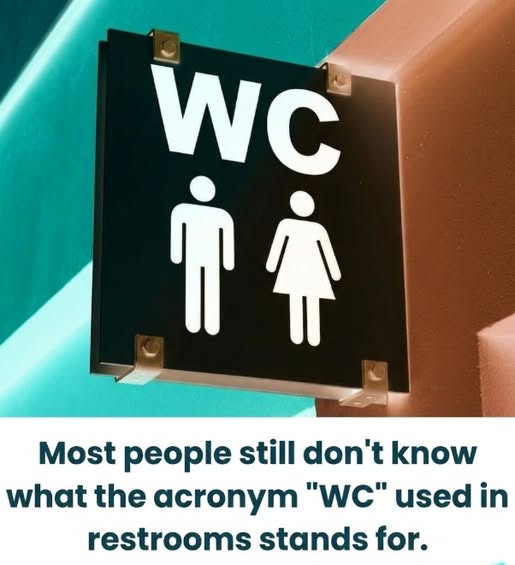
Around the world, the spaces dedicated to personal hygiene go by many different names, reflecting language, culture, and local habits. In the United States, people commonly use terms like “restroom” or “bathroom,” while in the United Kingdom, you’re more likely to hear “toilet,” “loo,” or “lavatory.” For travelers, this variation can occasionally create confusion—especially when encountering unfamiliar labels such as “WC” on public signs.
The abbreviation “WC” stands for “water closet,” a term that dates back to the 19th century. It originated during a period when indoor plumbing was still evolving, and homes began incorporating small, separate rooms specifically designed for toilets. At the time, these spaces were distinct from bathing areas, offering a more practical and hygienic solution compared to earlier methods that required manual water handling.
As plumbing systems became more advanced, the term remained in circulation and gradually spread across different countries. Today, “WC” is widely recognized and frequently appears in public places such as airports, train stations, and commercial buildings. While many people understand it simply as a sign for a restroom, fewer are aware of its historical background, which adds an interesting layer to an otherwise everyday label.
Despite the differences in terminology, the purpose of these facilities remains universal: to provide a clean, private, and functional space for essential needs. The continued use of “WC” highlights how language evolves while preserving elements of its past. Even the simplest signs we encounter daily can carry a story, reminding us of the practical innovations that shaped modern living.