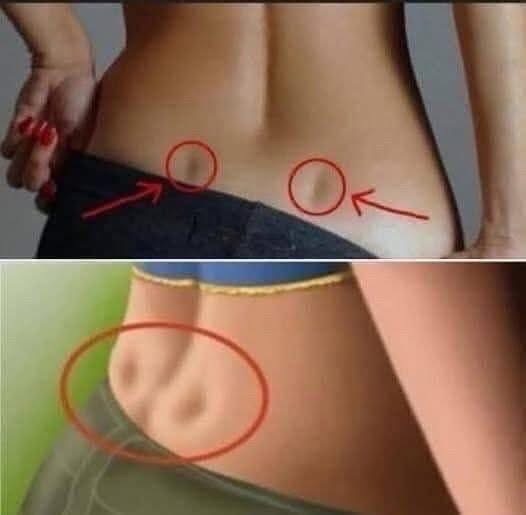
The small indentations visible on the lower back, just above the hips, are often known as “dimples of Venus.” Though easy to overlook, they tend to stand out for their symmetry and the way they gently shape the body’s natural contours. Their appeal lies in their subtlety—rather than being a bold feature, they enhance the overall balance of the body in a quiet and natural way.
These dimples are entirely genetic and are not influenced by exercise, diet, or lifestyle habits. Unlike many physical traits that can change over time, they are simply part of an individual’s natural structure. This means they remain consistent regardless of fitness level or body changes, making them a fixed characteristic that varies from person to person.
From an anatomical point of view, these indentations form where the upper part of the pelvic bone sits close to the skin. In this area, connective tissue links the skin to the bone, creating a slight inward curve. Because there is less muscle and fat covering this region, the dimples can appear more defined. Their placement often reflects the body’s natural alignment, contributing to their balanced appearance.
Although they are often associated with aesthetics and have been appreciated in art and culture over time, these dimples do not serve a specific function in terms of health or performance. They are simply a natural variation in human anatomy. Recognizing this can help shift the focus from comparison to appreciation, highlighting that such features are just one of many ways the human body expresses diversity and individuality.