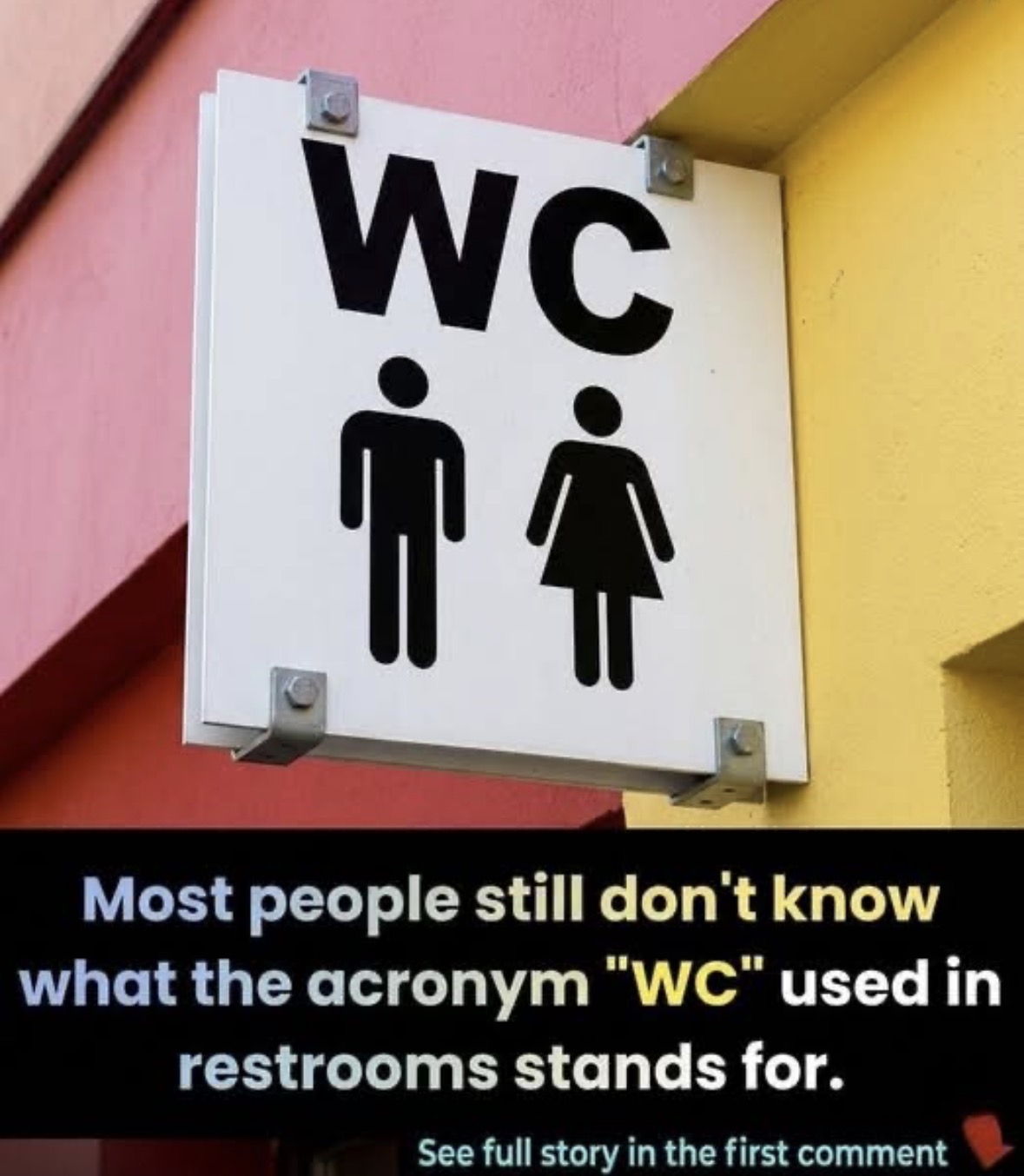
Across the world, the space dedicated to personal hygiene goes by many names, each shaped by local language and custom. In the United States, “bathroom” and “restroom” are commonly used, even in places where no bath is present. In the United Kingdom and parts of Europe, the vocabulary expands to include terms like “toilet,” “loo,” “lavatory,” and the often puzzling abbreviation “WC.” For travelers, this variety can feel confusing at first, especially when unfamiliar signage appears in public places.
Among these terms, “WC” tends to spark the most curiosity. While many recognize it as a sign pointing to a toilet, fewer know its origin. The abbreviation stands for “water closet,” a phrase that dates back to the 19th century. At that time, indoor plumbing was still developing, and homes were beginning to incorporate more advanced sanitation features. A “water closet” referred specifically to a small, enclosed space designed for a flushable toilet, separate from other areas of the home.
As plumbing systems improved, this concept became more common in urban living. Earlier homes often relied on outdoor facilities or basic setups that required manual effort. With the arrival of indoor plumbing, placing toilets inside the home became possible, but they were usually installed in compact, private rooms rather than combined with bathing areas. This separation helped maintain comfort and cleanliness, which were becoming increasingly important in residential design.
Today, the abbreviation “WC” remains widely used in many countries, particularly in Europe and Asia, where it appears on signs in public buildings such as hotels, train stations, and restaurants. Although the full term “water closet” is rarely spoken in everyday conversation, the abbreviation continues as a practical and recognizable label. It serves as a small reminder of how language, design, and innovation evolve together, even in the most routine aspects of daily life.